
Mindset
A couple epiphanies, and some miscellaneous things that make me smile.

Practicing

I don’t know what changed this year, but I think it must be the community building that I attempted. I say attempted, because I think community building is never done, and I most definitely am still learning how to build it, but I’ve tried really hard, and I am amazed at how much closer my classes feel this year. I also do feel more equipped and less overwhelmed (although the overwhelm is by no means a stranger), which actually leads me to feel like I should be learning and professionally developing so much more than I am (ah yes, welcome back overwhelm), but it’s nice to zoom out and look at the one real goal that I had set for myself this year. And to see that the results I only hoped to have are somewhat blossoming. The community is building.
Except for in one class.
That’s not entirely fair, I suppose. They’ve warmed up a bit, but that class period always feels like an awkward silence. I’ve tried all the usual community-building things that have seemed to work in my other classes. And it’s all fallen pretty flat. No matter what I asked the students to do, or how I tried to scaffold, they would not turn and discuss with each other.
It may seem dramatic, but I was beside myself. In a desperate search for seasoned advice, I asked my mentor for any ideas she could give me. She suggested that I teach my students how to have a discussion, even explaining the reason(s) why it mattered to be able to have a discussion. I was amazed that I’d never thought of that before. Here was I, assuming that every student must surely know what I meant when I told them to have a discussion with their partner or their table. But of course, we’ve all been in the “discussion” where one person presents all the “right” answers and everyone else nods their heads in assent. This sends mixed messages about what passes as a discussion. Does every group member have to participate? Can one group member carry the weight for everyone else? Is it really necessary to have the discussion in the first place?
I was worried that it might be overkill, but I had a conversation with my students to set expectations for what a classroom discussion should look like. I started by explaining my goal for teaching students how to have group discussions, and tied it back to the book groups that the students themselves would be facilitating later in the unit. Having established the reasons why I cared about group discussions, I asked students to share either good experiences or bad experiences that they’d had in group work before, and they narrowed it down to two essential things: (1) Group work means that everybody contributes, and (2) Group work is more than copying answers from each other.
With those two simple expectations established, I set them free to work in a simple partner exercise to practice vocabulary words that we’d spent the first half of class learning. It was a complete transformation! Nearly every single student in the classroom was working with their partner, even when they seemed slightly reluctant to do so.
And when I reflected back on the change, I realized that I was the original problem. I wasn’t setting high expectations for my students. I was frustrated that they were hindering their own learning, when in reality I just needed to cultivate the right conditions to help them learn. They needed to see purpose. They needed to understand the expectations. I needed to get out of the way and stop crippling them by assuming that they wouldn’t engage. I had been stuck in a deficit mindset.
In the midst of this reflection, I happened upon this golden quote from Adrian Neibauer about the start of the school year:
Remember, when things get tough, as they most certainly will, mindset matters.

Yes, I seem to be continually learning just how much mindset matters if we want our students to succeed.
Experiencing (Or, Meeting Goals)

The end of class has been a struggle for me this year. I had a very clear procedure last year that I loved, but this year it seems like I’m always sending the students out the door with the bell, leaving them frantically packing up around the room and bottlenecking at the hanging files where they keep their writer’s notebooks. I think I have a fear of not teaching bell to bell and having wasted time, but I struggle to know what the “perfect” amount of time would be to leave for students to put their things away and magically finish at the bell. I’ve realized that that “perfect” amount of time doesn’t exist. Students can clean up remarkably fast if they want to spend a minute or two on their phones, and they can clean up remarkably slow if they want to kill time before the bell.
I recently had an epiphany: what if I let my students clean up earlier than necessary, with the intention of bringing them back to their seats for one final discussion/debrief? Since my epiphany, I’ve attempted this with varying degrees of success in a few of my classes. One major obstacle, obviously, is that once students clean up, they’ve switched into “class is over” mode. But I think that I could combat that with clear expectations, even an explanation of why I value coming back together to debrief at the end of the day. One other obstacle remains the differing amounts of time that each class seems to need in order to effectively clean up—something that might be fixed by a friendly competition, or again, simply by clear expectations. And then there remains the issue that I sometimes butt up against the bell anyway, but I have timers in my classroom to remedy that precise issue. I’ve always called myself a time optimist—one who thinks they have more time than they really do.
But if I boil down all of these thoughts, I’m left with the desire to help students process and make connections at the end of the lesson. Sometimes that’s where the most important learning happens, so if I let my students simply whisk themselves away, we’re missing a key component of learning. And so. My goal for the remainder of the month is to close class. Not just to clean up and let the bell signal our departure, but to help students’ minds work through the new information that they’ve gathered. To bring the students into yet another small learning community for the brief moment before they move on to other things.
Learning
I’m teaching my students how to provide quotes in context this week, and so I was delighted to see this note from Kate Dusto in my feed today. What a fun and interactive way to hone students’ problem solving skills while teaching a new concept! I think I’ll expand on the exercise to add in the idea of providing context from the story that we’re reading, so that students learn how to weave their quotes into the writing of their paragraphs.
Odds and Ends
My department uses CommonLit to get a baseline sense of where students are in their grade-level reading performance at the start of the year, and then we provide that data broken down into standards so that students can see their starting point, and eventually their growth over the course of the year. It’s a lot of meaningless numbers for the students at first, but as they get used to viewing the data, it’s exciting to see them understanding what they’re working towards—as well as them getting excited when they can see the growth they’ve had!
On Friday during reading time I was passing out the data sheets that I created for students to see how they performed on the pre-assessment, and I knew that if they unfolded the paper they’d be sucked away from their books and start trying to make sense of the numerous percentages on the page, as well as start comparing their performance to their friends’. So before I began passing out the papers, I announced, “I am about to bring a sheet of paper to you. It is folded. It will be tempting for you to unfold it and read it, but please resist the urge. I promise we’ll go over the paper as soon as reading time is over.”
I was in the middle of passing out papers when one young man got his and immediately began to unfold it…only to have the paper yanked out of his grasp by his friend, who loudly whispered, “RESIST THE URGE!” and slammed the paper back on the desk. It made me laugh so hard. I guess it shows that students really are listening, even when you think they aren’t.
Positive Miscellany

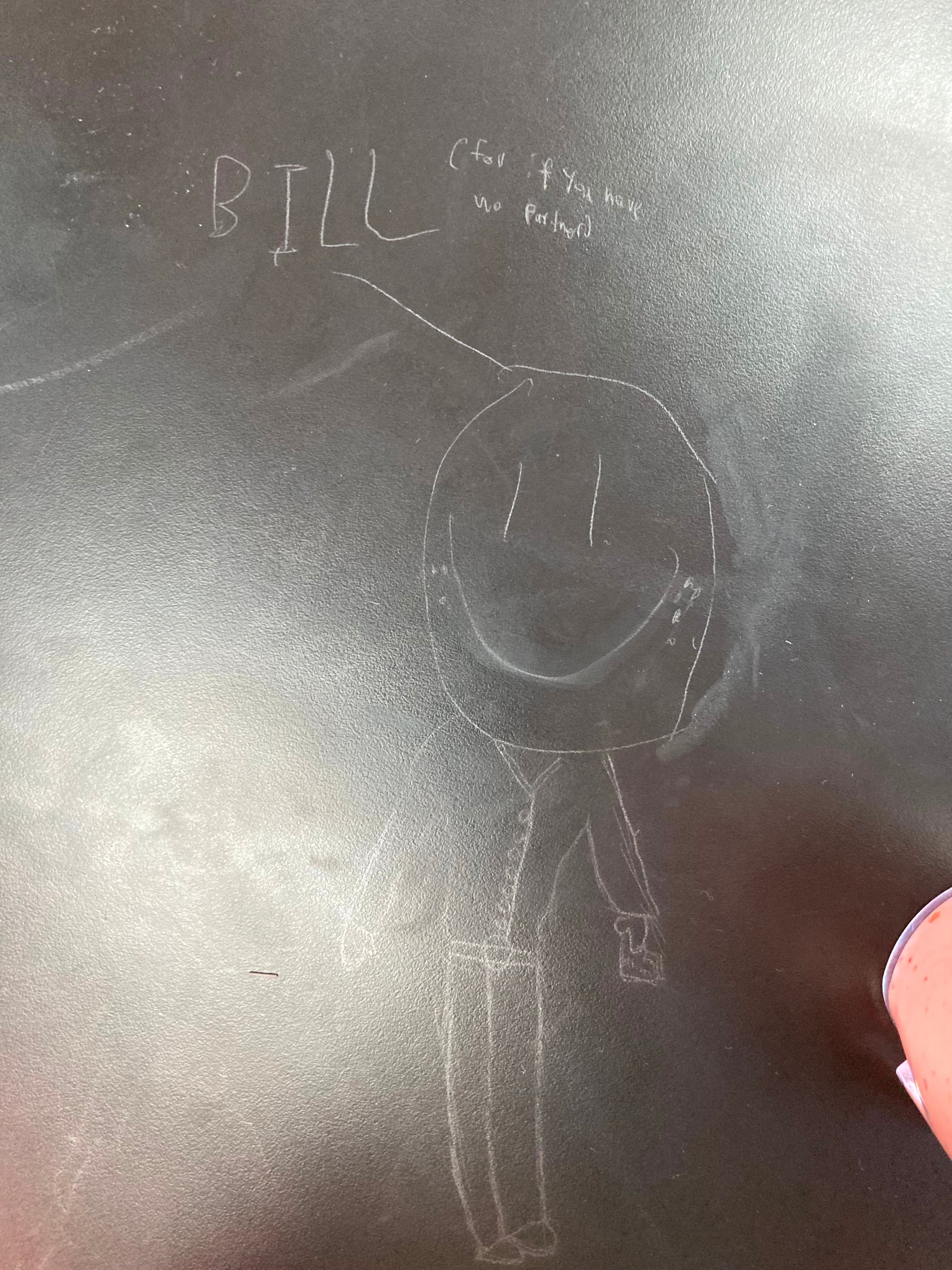
🌻 I discovered the ever-friendly BILL drawn onto one of the tables in a fellow teacher’s classroom when we were gathering for lunch. What a handy doodle for if you have no partner.
🌻 This meme from Joel J Miller was too good to pass up. I definitely shared it with my Librarian Book Club, which ironically meets via Zoom.
I think that’s all for now.
Until next time,
Beth
Let me know how your quote puzzles go! I love your idea to adapt it and add more context. That's always a struggle for students.